
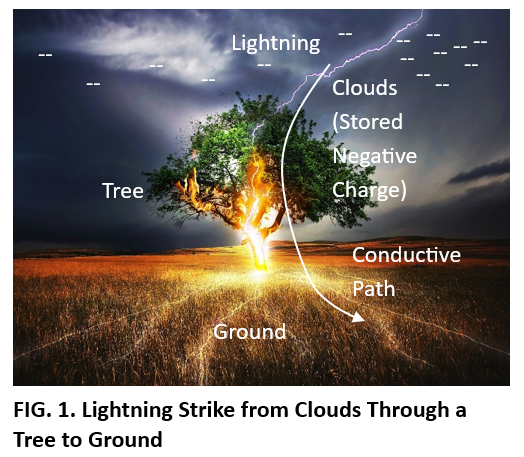
 Almost everyone has experienced an electrostatic discharge (ESD) event – a lightning bolt! Lightning is the result of discharging an enormous amount of stored electrostatic (negative) charge from the clouds to the ground as shown in FIG. 1, usually through an object such as a tree.
It is so powerful that it can easily split trees in half and electrocute you in a microsecond. It is an extremely powerful source of energy and may produce voltages in excess of 300 million volts having currents of approximately 300,000 amperes! Compare this to your home electrical system which supplies alternating 120 volts and 15 – 20 amperes per outlet.
The extreme voltages produced by the accumulated cloud charge is strong enough to strip the electrons from their air molecules thereby ionizing the air and forming a conductive plasma, from the source of stored electrostatic charges (the cloud) to one end of a grounded object (the top portion of the tree). The large current then flows from the top of the tree through the tree trunk and eventually to the bottom of the tree where it is dissipated into the ground. A conductive path is formed which allows charge to flow from the clouds through the tree and eventually into the ground.
Electrostatic discharge events are not only limited to charged clouds and the production of lightning. Did you know that by just walking across a carpet, especially in the wintertime, you will most probably generate a large amount of stored electrostatic charge, similar to the stored electrostatic charge in clouds.
The voltages and currents produced by this human effort are substantially less than that produced for lightning but still may exceed 20,000 volts and 50 amperes of current! These reduced levels of voltage and current however are powerful enough to destroy electronic devices and corrupt data files.
As you walked across the carpet, the frictional sliding action between the soles of your shoes and the carpet may have stripped electrons from the carpet and transferred those electrons to your body depending upon the type of material used to manufacture your shoe soles and the carpet. You may have accumulated negative charge (electrons have negative charge) similar to the clouds gaining negative charge. The carpet will therefore became positively charged (when electrons are stripped from the carpet the positive charge of the carpet’s protons is not balanced anymore by the transferred electrons).
The amount of negative charge which can be transferred to your body depends upon a number of factors. The most important factors include the carpet’s capacity to give up electrons, the capacity of your body to accept the transfer of electrons from the carpet, and the ambient (localized) relative humidity. The triboelectric chart lists common materials and ranks them according to their ability to lose or gain electrons when frictionally rubber together. Depending upon type of shoe sole and carpet materials, you may also accumulate a positive charge instead of a negative charge.
The triboelectric chart is more fully described in the article “What is the Triboelectric Chart?”, and the article “What is the Relationship Between Relative Humidity and Static Electricity?” describes the relationship between electrostatic charge build-up and relative humidity. As you approach a grounded metallic object like a light switch, computer, computer keyboard, or other electronic device with your charged finger, you will most probably experience a short and sometimes painful shock (a spark is produced) as the accumulated charge on your body is quickly dissipated through the object to ground.
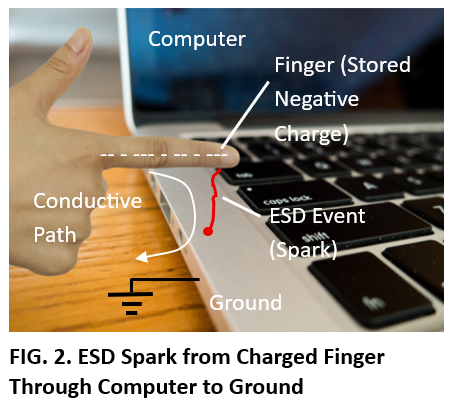 FIG. 2 illustrates a typical office situation. As you approach the computer with a charged finger, eventually an electrostatic discharge (ESD) event will occur which will ionize the air between your fingertip and the grounded computer. A conductive path will then form from the fingertip through the ionized air and through the computer to ground allowing the stored negative charge to dissipate into the ground. The spark that is generated between your fingertip and the computer is similar to the cloud produced lightning bolt and is an uncontrolled plasma discharge which occurs within billionths of a second! Fortunately, the human generated ESD event does not have the same energy level as the storm produced lightning but does have sufficient energy to completely destroy both the sensitive circuits of, and any stored data within, your computer.
The accumulated charge on your body may be positive or negative depending upon the types of material and their position in the triboelectric series, and the painful feeling you experience (the “zap”) is the result of the uncontrolled flow of stored electrostatic charge that you previously accumulated as you walked across the carpet. All BumbleBee™ models controllably discharge both positive and negative accumulated charges from you directly to ground eliminating the unpleasant “zap” feeling and bypassing your computer. Your computer and data remains safe from the hazards of ESD.
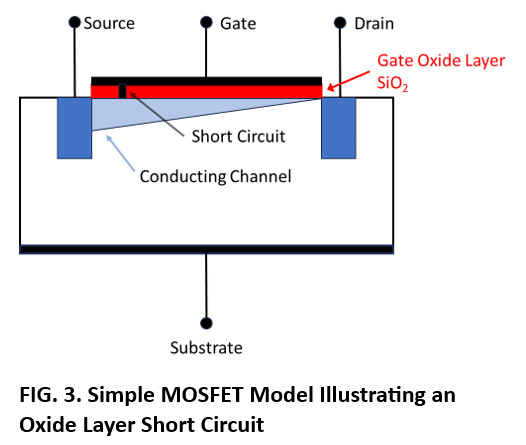 Modern electronic circuits are comprised of Metal Oxide Semiconductor Field Effect Transistors, commonly referred to as a MOSFETs. A simplified two-dimensional model of a MOSFET is shown in FIG. 3.
The MOSFET has external electrical connections consisting of the source, gate, drain and substrate. For many MOSFETs, the substrate terminal is connected to the source terminal.
Under normal MOSFET operation, a voltage is applied between the gate and source terminals and a conducting channel is formed under the gate terminal which spans from the source terminal to the drain terminal. A thin layer of silicon dioxide (SiO2 – glass) insulates the gate terminal from the source, drain and substrate terminals (the conducting channel is part of the substrate). For proper transistor operation, the thin layer of SiO2 must always insulate the gate terminal from all of the other MOSFET terminals.
The thin oxide layer at normal gate to source voltages is a very good insulator. However, as the gate voltage is increased eventually the insulating properties of the SiO2 oxide layer breaks down and forms a short circuit between the gate and commonly the substrate, although other terminal short circuits may occur. To determine the gate oxide breakdown voltage, the source, substrate and drain terminals are all grounded and a voltage is applied to the gate terminal until a gate current begins to flow.
The gate voltage at which a short circuit is formed is called the MOSFET gate oxide breakdown voltage, and is defined as the maximum voltage the insulating layer between the gate and the other terminals can withstand before it conducts current and forms a permanent short circuit.
Typical MOSFET gate oxide breakdown voltages ranges between +/-5 to +/- 20 volts, a relatively low value compared to human generating electrostatic voltages. A breakdown of the insulative gate oxide layer occurs if the gate terminal comes into contact with the human generated electrostatic voltages which will cause irreversible damage to MOSFET circuits.
As previously mention above, human generated electrostatic voltages can easily exceed 20,000 volts, more than enough voltage to breakdown the thin SiO2 insulating oxide layer on MOSFET transistors and permanently destroy computer circuits. All BumbleBee™ models can safely dissipate up to +/- 30,000 volts of human generated electrostatic charge, and when properly used will provide ESD protection for your computer and data.