

 To understand the importance of relative humidity and its relationship to static electricity, we first review absolute and relative humidity, the two types of humidity commonly discussed by the scientific community. A simple model for an office heating and ventilation system is then presented to illustrate how both the absolute and relative humidity levels change throughout the ventilation system.
The rate of evaporation of water from surfaces and the relationship between relative humidity and the rate of evaporation is then discussed. With a high relative humidity, the evaporation rate of water from surfaces is diminished and less water is evaporated from the surface, leaving the surface “moist”. The moist surfaces are more conductive than a perfectly dry surface and more easily dissipate electrostatic charges.
Finally, a simple electrical circuit is presented to model the relationship between relative humidity and the dissipation of electrostatic charges.
Both absolute humidity and relative humidity measure the amount of water vapor (not water) present in a given volume of air. Water vapor is considered a gas and is the gaseous form of water produced when liquid water evaporates or is heated (boils) and transforms into a gas, or when ice sublimates directly into a gas. Steam is a good example of water vapor. Fog is not considered water vapor but is just tiny water droplets suspended in air and is considered a colloidal system.
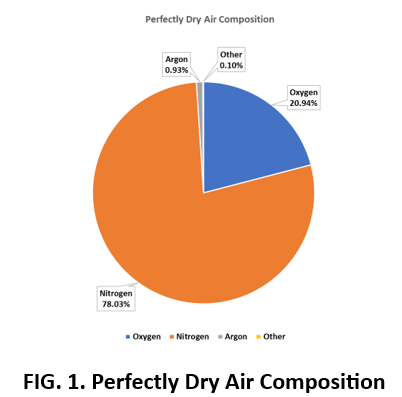
Perfectly dry air (having no water vapor), is composed volumetrically of gases including oxygen (20.95%), nitrogen (78.08%), and trace amounts of argon (.93%), carbon dioxide (.04%) and other gases as shown in FIG. 1.
Having no water vapor, both the absolute humidity and relative humidity of perfectly dry air are both zero. “Moist” air often refers to perfectly dry air having water vapor. As we add water vapor to perfectly dry air, some of the other gas molecules are displaced to make room for the water molecules which decreases their volume percentages.
We will now define absolute humidity and relative humidity and give a few examples to further your understanding of these terms.
Absolute humidity is defined as the ratio of total mass of water vapor (grams) within a given volume of air to the given volume of air (cubic meters):
Absolute Humidity = total mass of water vapor (grams) / given volume of air (cubic meters)
Absolute humidity does not depend upon temperature or pressure. The units of absolute humidity are grams/m3.
For example, let’s say in one cubic meter of air there is 3 grams of water vapor (remember water vapor is different than water). The absolute humidity would then equal 3 grams/m3.
Relative humidity is defined as the ratio of total mass of water vapor (grams) within a given volume of air to the maximum mass of water vapor (the saturation mass) that can be held in the given volume of air at a given temperature, expressed as a percentage:
Relative Humidity = (total mass of water vapor (grams) within a given volume of air) / (the saturation capacity mass (grams) of water vapor at a given temperature for a given volume of air)
Relative humidity is a percentage that indicates how saturated the air is with water vapor at a given temperature. As will be discussed later, relative humidity also affects the evaporation rate of water from a surface, and high relative humidity reduces the evaporation rate from a surface.
Both the absolute humidity and relative humidity levels may be increased with a humidifier which adds water vapor to dry air. The humidifier increases the total mass of water vapor within a given volume of air.
For example, a given 1 cubic meter of air at a given temperature (temperature T1) can maximally hold 5 grams (the saturation mass) of water vapor before precipitation occurs. The amount of water vapor actually being held by the 1 cubic meter of air is 2 grams. The relative humidity is therefore 2 grams/5 grams = 40% relative humidity.
Please note that relative humidity changes with temperature because the saturation mass (grams) of water vapor that can be held by the air before precipitation occurs is temperature dependent. Raising the temperature of air increases its ability to hold more water vapor (the saturation mass increases) and therefore, the relative humidity decreases.
Lowering the temperature of air decreases its ability to hold significant amounts of water vapor and the relative humidity increases. Lowering the air temperature further will eventually cause the water vapor to condense and form rain, fog, dew and or clouds.
As another example, the same cubic meter of air as before having the same amount of water vapor (2gms) is now heated to a higher temperature T2. At this higher temperature, the saturation mass of water vapor (the maximum amount of water vapor mass that can be held by the air before precipitation occurs) now increases to 8 grams. The rise in temperature allows the air to hold more water vapor before precipitation occurs and therefore the new relative humidity value is 2 grams / 8 grams = 25% relative humidity.
At lower temperatures the saturation capacity of air to hold water vapor decreases causing the relative humidity to increase. At higher temperatures the saturation capacity of air to hold water vapor increases and the relative humidity decreases.
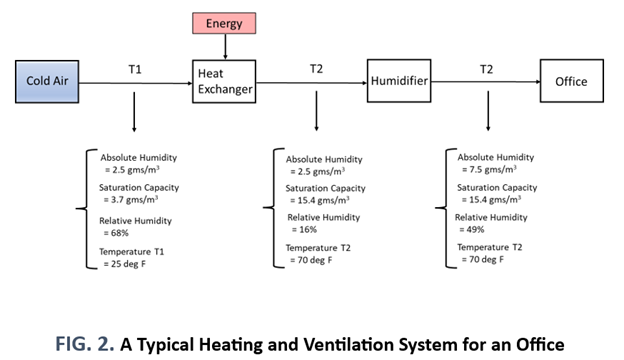 As a more comprehensive example, let’s consider the heating and ventilation system for an office as shown in FIG. 2.
In the winter season, most heating and ventilation systems bring in cold outdoor air at a temperature T1. For this example, temperature T1 is given a value of 25 deg F. Additionally the absolute humidity equals 2.5 gms/m3 and the saturation capacity is 3.7 gms/m3 at temperature T1. Using the definition for relative humidity, the calculated relative humidity value of the cold air is given as:
Relative Humidity = Absolute Humidity/ Saturation Capacity = (2.5 gms/m3) / (3.7gms/m3) = 68% (at T1)
The outside cold air is then heated to a temperature T2 by a heat exchanger. The heated air has a higher saturation capacity (remember hot air can hold more water vapor) of 15.4 gms/m3 and therefore the relative humidity of the heated air now decreases at the output of the heat exchanger.
The relative humidity of 68% of the outside air at temperature T1 = 25 deg F decreases to 16% as it is heated to the inside (thermostatically set) air temperature of T2 = 70 deg F by the heat exchanger, but before entering the humidifier:
Relative Humidity = Absolute Humidity/ Saturation Capacity = (2.5 gms/m3) / (15.4 gms/m3) = = 16% (at T2)
The heated air at temperature T2 is then ported to a humidifier which increases the absolute humidity by increasing the mass (amount) of water vapor by an additional 5 gms/ m3. The absolute humidity of the air after leaving the humidifier is now 7.5 grams/m3.
The saturation capacity of 15.4 grams/m3 of the heated air does not change (the temperature of the air remains at T2 before and after the humidifier), but the relative humidity now increases to 49% ((7.5 gms/m3) / (15.4 gms/m3)) after the humidifier. This humidified air is then circulated to the office(s) by the ventilation system.
Relative Humidity = Absolute Humidity/ Saturation Capacity = (7.5 gms/m3) / ( 15.4 gms/m3) = = 49% (at T2)
The saturation capacity of air at a specific temperature is calculated from the saturation vapor pressure of water at the given temperature using an empirical formula such as the Antoine equation, and the ideal gas law to calculate the density of water vapor at saturation. This calculation is beyond the scope of this article.
As shown in this example, the relative humidity of an office area is very much dependent upon the air temperature and the ability of the humidifier to add moisture to the heated air.
A relative humidity range of 40% – 60% is usually quoted as being an ideal range for mitigating the build-up of static charge in an office or manufacturing setting. However, for practical reasons the most common inside relative humidity range is 30% to 40%.
For the BumbleBee Model 300, the relative humidity range of 30%-40% is presented as an amber color RH-LED, and the relative humidity range of 40% – 60% is presented as a green RH-LED. Using a BumbleBee electrostatic dissipater will provide protection for your electronic devices by helping to insure a safe electrostatic free work environment irrespective of relative humidity levels.
The next topic to consider in understanding the relationship between relative humidity and static electricity is the concept of evaporation. Evaporation is defined as the process where a surface liquid (in this case water) transforms into water vapor. The water vapor is then dispersed into the air either through air circulation or by diffusion.
As a practical example each of us has experienced, consider hot “muggy” days during the summer months having high relative humidity. During these days you feel very uncomfortable having hot and clammy (wet) skin.
The reason for this uncomfortable feeling is that your body relies on the evaporation process (especially the evaporation rate) to cool you. A high evaporation rate translates into a large cooling effect, and a low evaporation rate translates into a smaller cooling effect. The faster your perspiration evaporates (the higher the evaporation rate) the cooler you become.
A high relative humidity decreases the evaporation rate and therefore diminishes the cooling effect. Also, the water which cannot evaporate forms a wet surface on your skin. You feel hot and clammy.
Low relative humidity increases the evaporation rate and therefore enhances the cooling effect. Also, the water which efficiently evaporates forms a dry surface on your skin. You feel cool and dry.
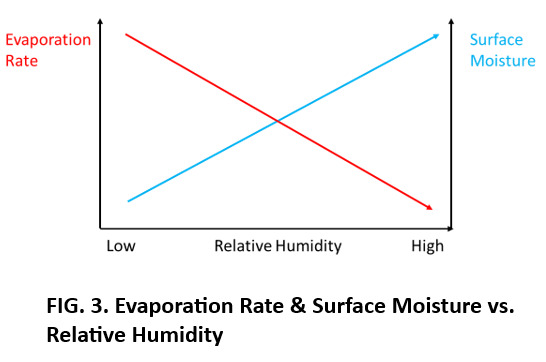
In summary, high relative humidity increases both the amount of water vapor in the air (by definition) and also tends to increase the surface moisture (by reducing the evaporation rate), as shown in FIG. 3. These two facts contribute to the importance of relative humidity in reference to static electricity.
 It is a well-known fact that pure water and pure water vapor do not significantly conduct electricity. However, pure water and pure water vapor have a tendency to dissolve impurities such as salts (in particular carbonates and phosphates) and minerals.
Pure water and pure water vapor containing dissolved salts and minerals may become good conductors of electricity depending upon the concentration of these impurities. The dissolved salts produce ions and cations which are charged particles and especially contribute to the conductivity of water and water vapor. Pure water and pure water vapor having dissolved impurities is commonly referred to as impure water and impure water vapor, both of which is conductive.
Low relative humidity increases the evaporation rate and therefore decreases the amount of impure surface moisture along with a corresponding decrease in ions and cations, increasing surface resistivity. Also, low relative humidity results in less water vapor in the air with a corresponding decrease in ions and cations, increasing volume resistivity.
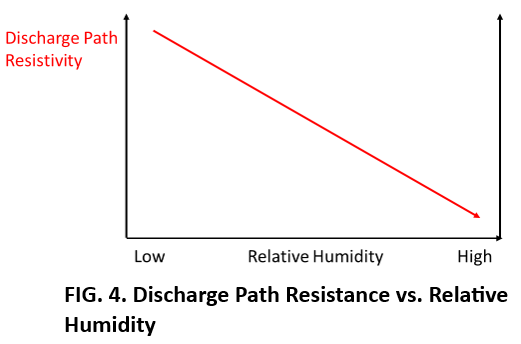 Both of these effects increase the resistivity of the discharge path for static electricity, and the accumulation of static electricity (charge) is enhanced, as shown in FIG. 4.
A higher relative humidity decreases the evaporation rate increasing the amount of impure surface moisture and therefore increasing the amount of impure surface moisture along with a corresponding increase in ions and cations, decreasing surface resistivity. Also, high relative humidity results in more water vapor in the air with a corresponding increase in ions and cations, decreasing volume resistivity. Both of these effects decrease the resistivity of the discharge path for static electricity and the accumulation of static electricity (charge) is diminished.
Referring to FIG. 5, a simplified one-dimensional electrical circuit according to the IEC 61000-4-2 standard is shown and models an electrostatically charged person. The model comprises a negatively charged capacitor C (150 Pico-Farads) in series with a resistor R (330 Ohms). The initial charge on the capacitor (represented by the initial capacitor voltage) may be either positive or negative.
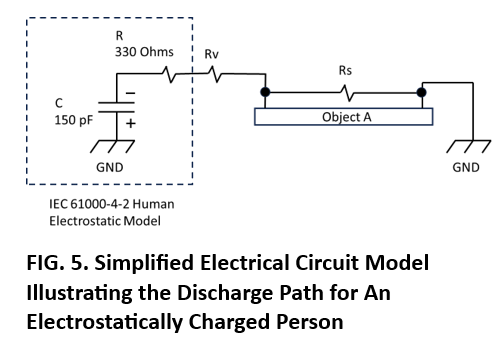 The capacitor C along with the resistor R may model a charged extended finger having the negative accumulated electrostatic charge residing near the tip of the finger and positioned close to an object A. Object A could be a computer keyboard, the top surface of your laptop, a USB memory stick, an LCD display, a calculator, a tabletop, etc.
Also illustrated in FIG. 5 is the resistor Rv which models the electrical volumetric air resistance and the resistor Rs which models the electrical surface resistance of the object A. In this simple electrical model, one end of object A is assumed to be connected to ground.
As shown in FIG. 5, resistors Rv and Rs are connected in series. The discharge path for the accumulated charge present on the capacitor C is through the series connection of resistors R, Rv and Rs to ground. A more comprehensive electrical circuit model would include multiple resistors Rv and Rs and multiple discharge paths.
With high relative humidity, both resistances Rv and Rs have lower resistance values (higher conductivity) because of more surface moisture and more water vapor, and therefore more dissolved ions. Lower Rv and Rs resistance values produce a faster discharge of accumulated charge from the charged capacitor C (person) to the ground connection of object A.
With low relative humidity, both resistors Rv and Rs have larger resistance values (lower conductivity) compared to their values for high relative humidity because of less surface moisture and less water vapor, and therefore less dissolved ions. Higher Rv and Rs resistance values produce a slower discharge of accumulated charge from the charged capacitor C (person) to the ground connection of object A.
All BumbleBee models have a controlled discharge circuit which completely discharges a person within 100ms of touching the discharge pad and additionally minimizes the “zap” commonly experienced when a charge person touches a metallic object. Furthermore, BumbleBee models 200 and 300 measure the relative humidity and use the relative humidity level to automatically adjust the period of the alert timer. For low relative humidity, the alert timer times out sooner (1 minute), and for high relative humidity, the alert timer times out later (up to 7 minutes) as illustrated in FIG. 6.
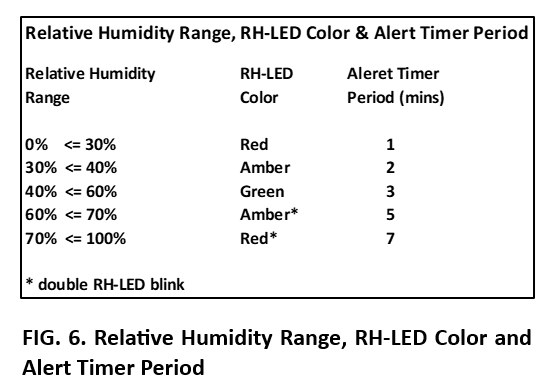 The BumbleBee model 300 additionally gives the user a visual indication of the 5 ranges of the localized relative humidity as illustrated in FIG. 6 (please refer to the article “What is Localized Relative Humidity?”).
In summary, relative humidity plays an important role in understanding electrostatic discharge mechanisms. A higher relative humidity increases both volumetric and surface conductivities minimizing the build-up of electrostatic charge, while a lower relative humidity decreases both volumetric and surface conductivities which subsequently favors the build-up of electrostatic charge thereby increasing the chances for a destructive electrostatic discharge event to occur.