
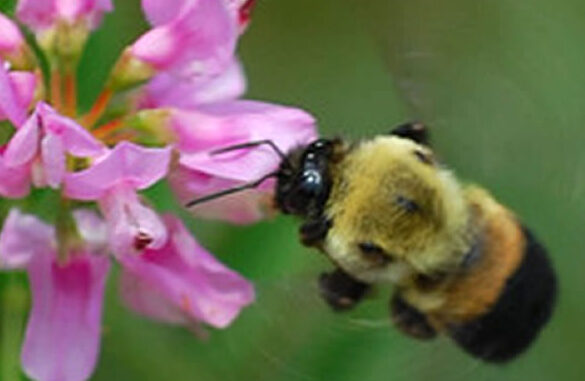
 Did you ever wonder where our fruit and vegetables come from? The answer seems obvious – from plants. But beyond this simple answer is the complex principle of pollination and the significant role the bumblebee plays in assisting with the creation of fruits and vegetables.
To bear fruit and vegetables, plants must first be pollinated. Without pollination, we would not enjoy many of our favorite fruits and vegetables including tomatoes, raspberries, strawberries, peppers, cucumbers, apples, alfalfa, blackberries, soybeans, sunflowers, beans, cherries, apricots, plums, almonds, peaches, rosehips, and eggplant, to name a few!
The pollination process is the act of transferring the pollen grains from the male part of the plant (the anther) to the female part (the stigma) of the plant. The pollination process begins when a plant produces pollen grains from the anther. These pollen grains are then transferred to the stigma of the plant where fertilization occurs with the subsequent production of fruits and vegetables, and more importantly, seeds. Seeds allow the plant to replicate and produce offspring (the next generation of plants).
Bees play an extremely important role in the pollination process by transferring pollen grains from the anther to the stigma. Bees act as the UPS delivery person carrying the pollen grains from the anther to the stigma enabling the fertilization process to occur. Without bees, the pollination process would lack one of the most efficient pollinators and the volume of fruits and vegetables available for consumption would be greatly diminished.
Bumblebees and honeybees are both pollinators. However, bumblebees are supurb pollinators and are 2 – 4 times more effective pollinators per bee over honeybees. Bumblebees work longer hours, they can work in colder, rainy weather and low light levels, and they work 50 – 200% faster per flower than honeybees.
Besides the bumblebees’ high endurance level, bumblebees are intelligent creatures and are taught to mimic simple tasks performed by their fellow bumblebees. For example, to increase the amount of pollen grains and therefore increase pollination efficiency, young bumblebees learn to “buzz pollinate” from more experienced bumblebees thereby increasing the number of pollen grains available for pollination. The bumblebees will grab the flower with the legs and flap their wings to mechanically vibrate the pollen grains from the anther making it easier to collect a large volume of pollen grains.
And to further assist in gathering the pollen grains, bumblebees beat their wings which frictionally produces a positive static charge on their bodies (see the article “What is Static Electricity?”). As they go to the next flower to collect the pollen, the pollen is negatively charged (the flower is literally grounded) and is attracted to the positive charged bumblebee (remember opposite charges attract and like charges repel). The electrostatic attractive forces produced by the positively charged bumblebee and the negatively charged pollen greatly increases the bee’s ability to collect significant amounts of pollen with little to no physical effort, making the pollen collection process very efficient and fast.
Also, by collecting the negatively charged pollen from the flower temporarily changes the electrostatic charge distribution on the flower. Subsequent bumblebee pollinators will detect this change in the flower’s electrostatic charge distribution and move on to another flower that has more pollen (and a more negative charge), further increasing pollination efficiency. Bumblebees use the principles of electrostatics to increase the volume of fruits and vegetables we consume in our daily lives.
 So, we named the company BumbleBee Technologies LLC in honor of this intelligent, hardworking and unselfish little insect who uses the principles of electrostatics to provide all of us with the fruits and vegetables we enjoy, making our lives a little more enjoyable.
And like the bumblebee insect, your BumbleBee electrostatic dissipator uses the same principles of electrostatics to provide you with a safe electrostatic free work environment, protecting your stored data, computer and your other electronic devices from the harmful effects of electrostatic discharges, making our lives a little more protected.