
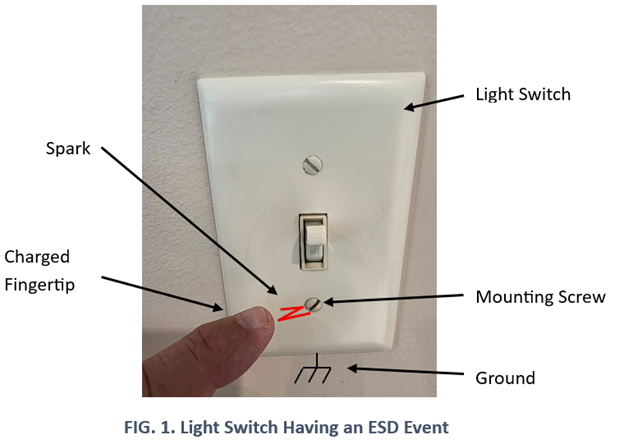
 Have you ever walked across a carpet and attempted to turn-on a light switch only to subsequently receive a painful electrostatic shock? You may have also observed a spark between your finger and the light switch (towards one of the grounded mounting screws of the light switch cover). What you experienced is an electrostatic discharge (ESD) event.
As you walk across the carpet, free charge is frictionally transferred from the carpet to you and accumulates on your body. The accumulation of charge on your body is subsequently discharged through the light switch to electrical ground. The spark you may have observed occurs because the accumulation of charge ionizes the air and allows the accumulated charge to flow from your body through the air and through the light switch to ground. The spark is similar to a lightning bolt and forces the normally insulative air to become conductive forming a conductive path and allowing the accumulated charge to flow from your fingertip through the air and through the light switch to ground as shown in FIG. 1.
The amount of free charge which is frictionally transferred from the carpet to your body depends upon a number of factors such as the type of contacting material (such as the material composition of the carpet and the soles of your shoes), the type of frictional contact between the materials (such as surface roughness), and the surrounding environmental conditions (such as relative humidity and temperature).
The triboelectric chart is an empirical listing of common materials by their ability to transfer charge (i.e., to lose or gain electrons) from a first material to second material. The chart comprises an ordered list of common everyday materials based on their ability to lose electrons (listed as positive) to their ability to gain electrons (listed as negative) and is illustrated in FIG. 2.
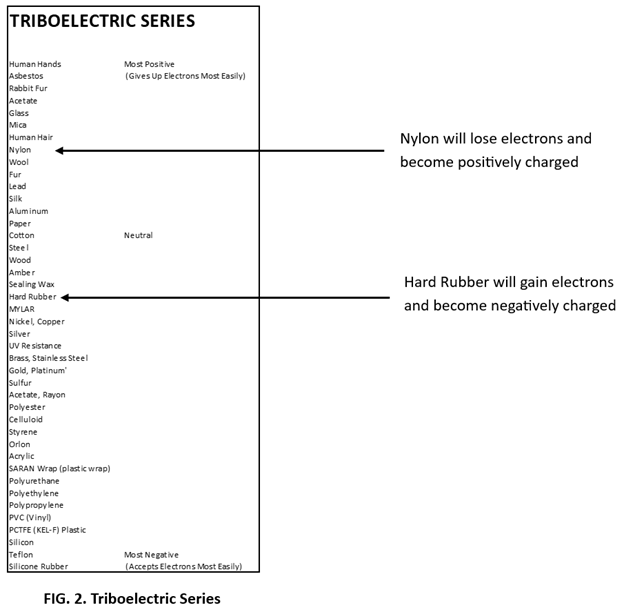 For the example above, if the carpet is made from nylon material and the soles of your shoes are made from hard rubber material, as you walk across the carpet the nylon will lose electrons becoming positively charged and the rubber material will gain electrons becoming negatively charged. Because you are in contact with the shoes, you will accumulate negative charge. If on the other hand you walk on a polyester carpet with hard rubber soles you would accumulate a positive charge.