
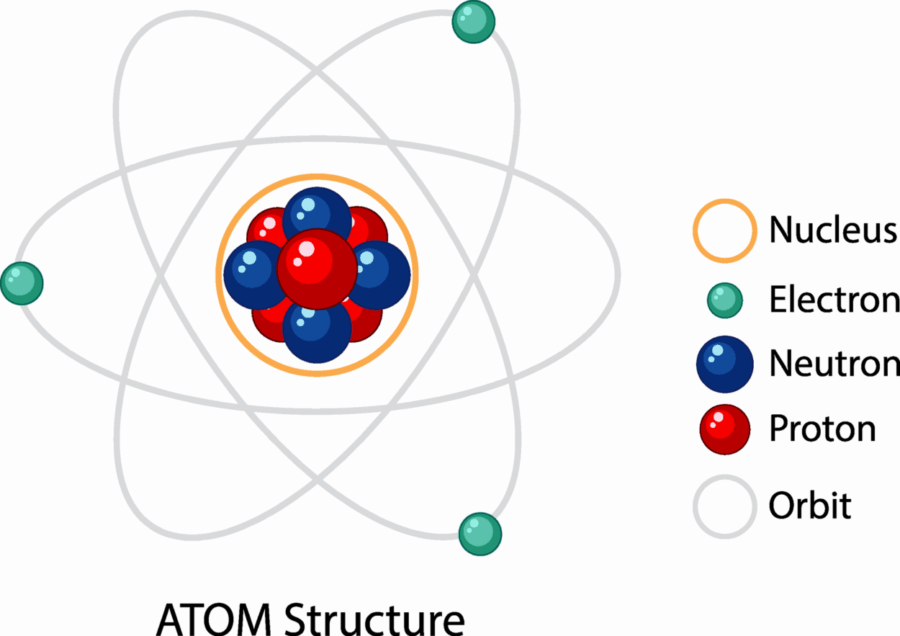
To fully understand how the BumbleBee static electricity surge protectors work, let’s review the concept of static electricity (static charge). Static charge is an accumulation of electrical charge, either positive or negative, which is stationary (i.e., fixed in space) and cannot normally move. A negative static charge is produced when normally charge-neutral matter acquires electrons over the number of available protons, and a positive static charge is produced when normally charge-neutral matter loses electrons over the number of available protons. Charge-neutral matter has an equal number of electrons (negative charge) and protons (positive charge).
The accumulation of static charge produces a force field (technically, an electric field) which acts on other charges in close vicinity to the static charge. As the amount of static charge increases, so does the force field. A point is reached where the accumulated static charge produces a strong enough electric field to ionize the air (ionized air acts like a conductor). Air is ionized when a sufficiently high electric field is supplied to an atom or molecule to pull an electron away from, or add an electron to, the atom or molecule thereby creating an electrically charged ion.
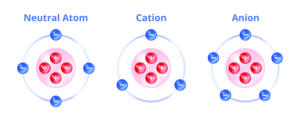 An electron pulled away from the atom or molecule produces a positive ion (cation), and the addition of an electron to the atom or molecule produces a negatively charged ion (anion). Mobile ions may conduct electricity. For example, the lithium battery powering your computer uses lithium ions (Li+) to carry current within the battery from the negative (anode) to the positive (cathode) electrodes through the electrolyte. Approximately 70 volts per one thousandth of an inch (.001 inches) is sufficient to ionize air, but this figure is an estimate and depends upon the relative humidity, temperature and air pressure. The ionized air provides a conducting path for free charge to flow.
Mobile ions may conduct electricity. For example, the lithium battery powering your computer uses lithium ions (Li+) to carry current within the battery from the negative (anode) to the positive (cathode) electrodes through the electrolyte.
Now consider the following example. A charge-neutral rug is positioned on a cement floor in your office. The charge-neutral rug has equal numbers of electrons and protons. Under the correct conditions, the electrons may be frictionally removed from the charge-neutral rug leaving the rug positively charged (there are more protons than electrons). As you walk across the carpet, the frictional forces remove the electrons from the rug and deposit free electrons onto you. You are now negatively charged and the rug is positively charged.
As you continue to walk across the carpet, you acquire more static charge (the frictionally transferred electrons) which subsequently produces an ever-increasing force field. A point is reached where the force field is sufficiently strong to ionize the air producing a conducting path which allows the once static (stationary) electrons to now flow from your fingertip to an earth grounded object (such as a desktop computer).
The electrostatic discharge (the spark) you observe is the ionized air carrying the now mobile electrons from your fingertip to the computer. After the electrostatic discharge, you and the computer are charge-neutral having equal numbers of electrons and protons. The electric (force) field equals zero.
Electrostatic discharge currents may exceed 30 amperes and voltages may exceed 20,000 volts. These current and voltage levels easily have sufficient energy to destroy the electronic circuits of computers and other electronic devices.
BumbleBee is placed in the conducting path and controllably discharges you without producing a spark or the nasty shock experience using patent pending discharge circuitry, preventing the destruction of electronic circuity and providing an electrostatically controlled workplace environment.
But what happens if you have a laptop computer operating on a battery and not physically grounded like the desktop computer? Most laptop computers have double insulation and are not directly connected to earth ground. In this case use the supplied AC-DC adapter which will dissipate any accumulated charge directly to ground. The billionths of a second electrostatic spark-like discharge is transformed into a millisecond-level gentle charge equalization having extremely low current.
If you do not use the AC-DC adapter, BumbleBee will controllably equalize the excess charge between you and the laptop thereby preventing an electrostatic discharge event from occurring and destroying your computer. By controllably equalizing the charges, BumbleBee forces the voltage difference between you and the laptop computer to zero. You will not experience a spark (the “zap”) and the charge will be dissipated slowly and smoothly.
You and your computer will be at the same voltage and will be sharing the original fingertip charge between you and your laptop. This equalized charge will eventually bleed off from you and your computer through natural paths such as the air (relative humidity dependent), high-impedance internal paths within the computer, through metallic charge reservoirs such as your laptop’s chassis, and capacitive coupling to earth.