You approach your office and sit in your chair, unpack your laptop computer and, without thinking, set your computer on your desktop, lift the lid and depress the ON/OFF button to turn-on your computer. Nothing happens!
You attempt to depress the ON/OFF button again and yet after the second power-on attempt still nothing happens. No boot! You hopefully say to yourself maybe the battery is discharged. You then connect the battery charger to your computer and after a while you proceed with a third power-on attempt but still nothing happens. No boot!
 A sick feeling in the pit of your stomach begins to slowly consume you knowing that you have expended months of effort inputting and storing data into your computer, but which is now inaccessible to you!
Losing critical data and corrupting software is a nightmare for all of us. It could take months of repeated work to recreate all of the lost data and software. Replacing (or attempting to repair) your broken computer and the time lost recreating the data is expensive. You ask yourself the question “What could have gone wrong with my computer?”.
The answer is complicated. However, it is most probably some type of circuit failure. Tiny integrated circuits within your computer having many millions of transistors all work together in synchronous fashion to provide us with an invaluable tool we use every day. But it only takes one transistor failure out of the many millions to cause havoc and destroy our precious data and electronic devices!
You tell yourself that it probably is a manufacturing error. But your computer has worked fine for years until now. You then remember that when you opened the lid of your computer and were about to depress the ON/OFF button, you felt a static discharge, a static shock. Could this electrostatic discharge incident, the static shock, have caused the problem? And if so, what could you have done to prevent this tragic accident?
The Threat of Static Electricity
It is well known fact that static electricity poses a significant threat to your computer and other electronic devices along with the data and software stored within these devices. Just walking across an office floor or shifting position in an office chair can produce high voltage static electricity exceeding 20,000 volts, which can easily destroy transistors and integrated circuits.
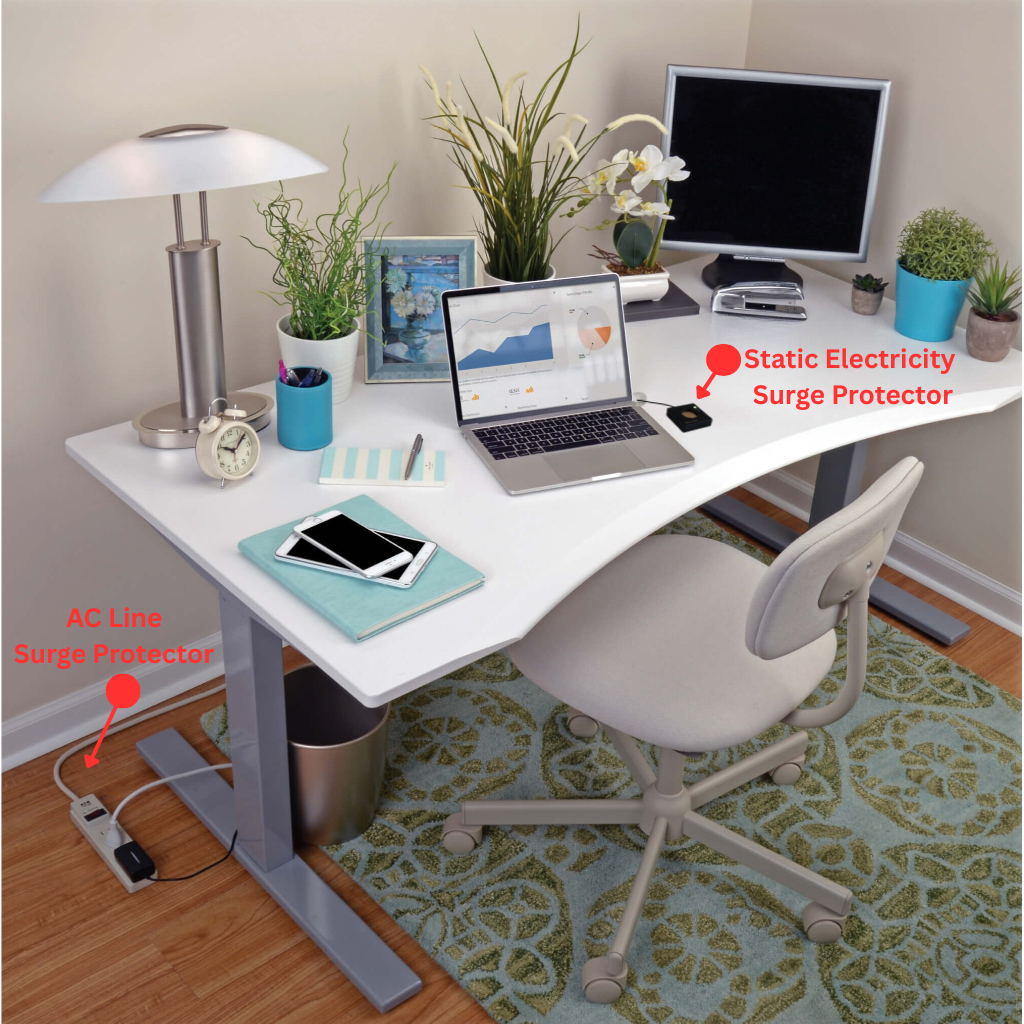
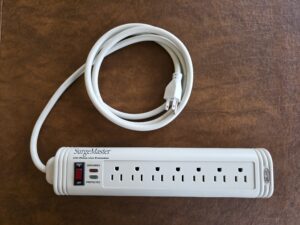 In a similar fashion to the AC surge protector installed in many offices today to prevent and control AC power line voltage surges, static electricity surges must be also prevented or controlled to maintain a safe electrostatic free workplace preventing the destruction of your computer and other electronic devices, data and software.
The BumbleBee Family of Static Electricity Surge Protectors
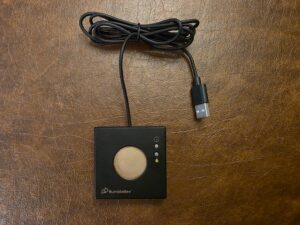
The patent pending BumbleBee family of static electricity surge protectors was invented to provide reliable and affordable static electricity surge protection for the home office, professional offices, healthcare patient rooms, and manufacturing and industrial workplaces.