All BumbleBee products are tested for ESD immunity and continued operation at the maximum voltage levels (Level 4) specified in the IEC 61000-4-2 standard. Additionally, the discharge pad is tested for an air and contact discharge of 30,000 volts. These voltage levels far exceed the maximum Level 4 test voltages specified In the International Electrotechnical Commission (IEC) international standard 61000-4-2 and easily surpasses voltage levels anyone should normally experience.
 The IEC 61000-4-2 ESD System Level Protection Standard is the international standard for testing products for electrostatic discharge immunity. Products that meet this standard can withstand ESD events without malfunction or damage at the specified test level voltage.
The chart summarizes the IEC 61000-4-2 standard ESD system level protection test voltages and the BumbleBee product’s test level voltages. The Level “X” test voltages are the ESD voltages applied to the discharge pad.
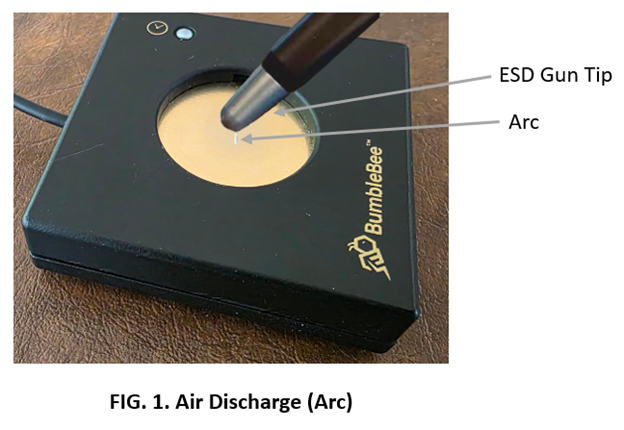 The air discharge test is defined as bringing the ESD test gun having the air discharge tip close to the product until an electrostatic discharge (an arc) occurs as shown in FIG. 1.
Air discharges are primarily used on insulative surfaces such as plastic enclosures, although BumbleBee’s discharge pad is tested for both air and contact discharges.
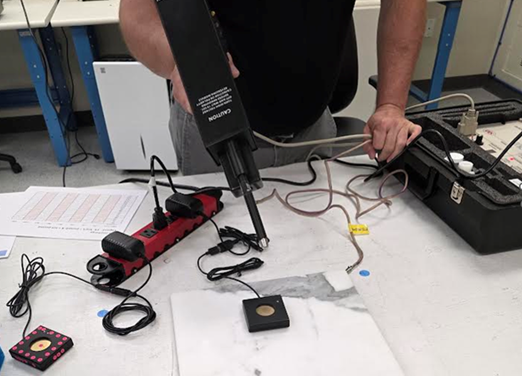
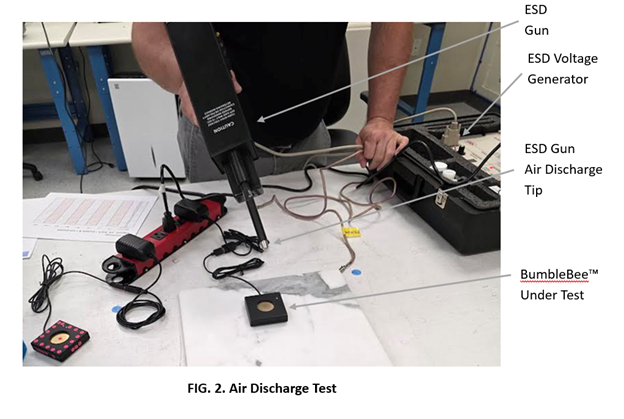
An example of an air discharge test setup for BumbleBee is shown in FIG. 2.
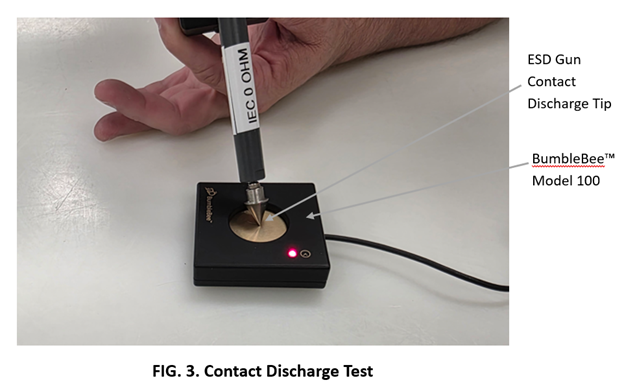
The contact discharge test is defined as first making physical contact with the contact discharge tip of the ESD gun to a conducting (metal) part of the product and then discharging the gun as shown in FIG. 3. A contact discharge does not produce an arc.
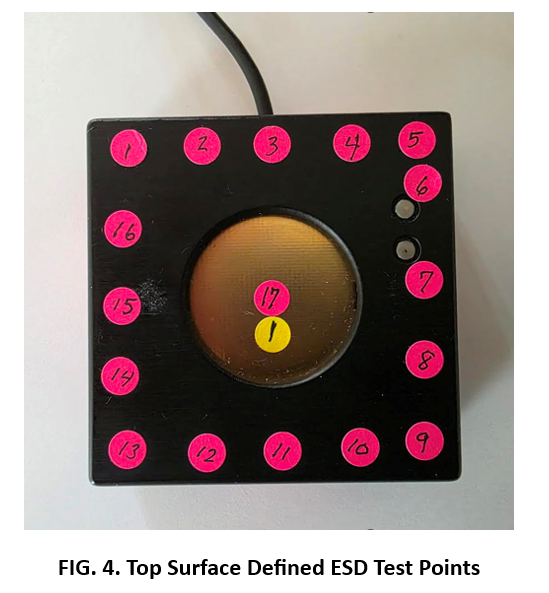
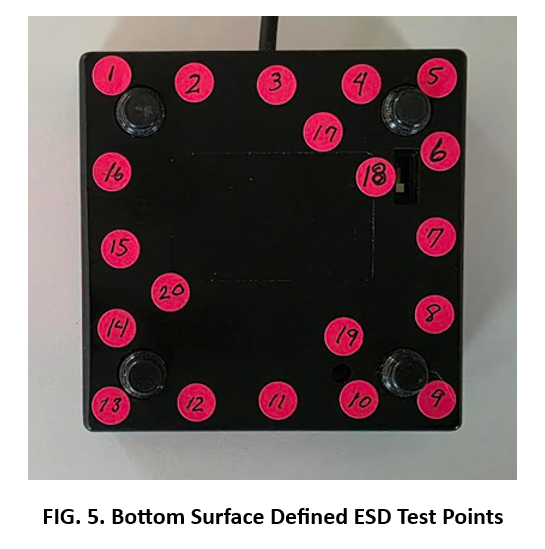
 Both air and contact discharges from the ESD gun are applied at designated test points defined by markers placed on all human touchable surfaces (top, bottom and side surfaces).
FIGS. 4 and 5 illustrate the test points for the top and bottom surfaces respectively. The red markers represent air electrostatic discharge test point locations and the single yellow marker represents the contact electrostatic discharge test point location. Each test point receives twenty of their respective type (air or contact) of ESD discharges.
 The testing is performed at a relative humidity of 12 +/- 2% and a temperature of 23 +/- 2°C. The lower relative humidity level represents the practical worst-case test condition.
After each electrostatic discharge, the design is then tested for operational compliance with respect to the product’s specification.